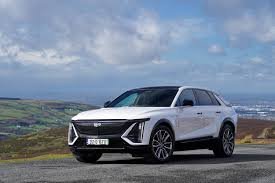
Cadillac Lyriq
The Cadillac Lyriq represents General Motors’ modern push into luxury electrification, utilizing the versatile Ultium platform. Equipped with a large 102 kWh lithium-ion battery pack, the luxury crossover delivers an EPA-estimated range of up to 314 miles for the Rear-Wheel Drive (RWD) model and 307 miles for the All-Wheel Drive (AWD) variant.
However, achieving those numbers depends heavily on how you configure the vehicle’s onboard software. The Lyriq features several selectable driving modes alongside advanced energy-recovery settings. Understanding how these systems interact with the battery can mean the difference between stopping frequently at DC fast chargers or maximizing your distance on a single charge.
1. The Core Driving Modes Explained
The Cadillac Lyriq provides four primary driving modes through its 33-inch diagonal advanced LED display. Each mode adjusts the throttle mapping, steering weight, suspension dampening (on equipped models), simulated cabin sound enhancement, and crucial to this topic—power draw from the battery.
Tour Mode
Tour Mode is the default setting for the Cadillac Lyriq, engineered specifically to serve as the baseline for everyday driving.
- Battery Behavior: This mode balances energy efficiency with standard luxury vehicle responsiveness. The throttle response is linear and smooth, discouraging sudden power spikes that drain battery cells rapidly.
- Range Impact: If you are looking to hit the official EPA numbers (307–314 miles), Tour Mode is where you should spend most of your time. On AWD versions, Tour Mode optimizes power split between the front and rear motors, often relying predominantly on the rear motor during steady highway cruising to reduce mechanical drag and lower your kilowatt-hours per 100 miles (kWh/100mi) consumption.
Sport Mode
Sport Mode transforms the driving dynamics of the Lyriq by tightening the steering feel and making the accelerator pedal significantly more sensitive.
- Battery Behavior: When you press the pedal in Sport Mode, the software requests instant torque from the electric motors without any dampening filters. In AWD models, both the front and rear permanent-magnet synchronous motors are kept active and highly alert, drawing continuous background current.
- Range Impact: Sport Mode reduces your driving range. The aggressive acceleration profiles lead to high thermal loads inside the battery cells, which causes the thermal management system to work harder to cool the pack down. This auxiliary cooling draws extra power. Frequent use of Sport Mode can lower your overall driving range by 10% to 15% depending on how aggressively you accelerate.
Snow / Ice Mode
Designed for low-traction environments, Snow/Ice Mode reshapes how torque is delivered to the wheels to prevent slipping.
- Battery Behavior: The throttle profile becomes intentionally dull or “numb.” Even if you press the accelerator down quickly, the computer gradually steps up the voltage sent to the motors to avoid spinning the tires.
- Range Impact: Because it actively prevents abrupt power surges and limits high-amp draws, Snow/Ice mode can accidentally act as an absolute “eco-range” mode under steady city driving conditions. However, because it is typically used in freezing temperatures, the range benefits are usually canceled out by the heavy energy demands of the cabin heater and battery preconditioning systems.
My Mode
My Mode is a fully customizable profile that allows drivers to mix and match individual settings. You can pair the lighter, more efficient steering profile of Tour Mode with the aggressive powertrain response of Sport Mode—or vice versa.
- Range Impact: Variable. If you set the powertrain performance to “Tour” or “Efficient” while keeping the steering stiff, your battery consumption will mimic Tour Mode. If you set the powertrain to “Sport,” expect identical range drops to the standard Sport profile.
2. All-Wheel Drive (AWD) vs. Rear-Wheel Drive (RWD) Efficiency
The motor configuration you choose dictates the absolute baseline of how driving modes pull power from the Ultium battery architecture.
| Feature / Metric | Rear-Wheel Drive (RWD) | All-Wheel Drive (AWD) |
| Motor Configuration | Single Rear Motor | Dual Motors (Front + Rear) |
| Total Horsepower | 340 hp | 500 hp |
| EPA Estimated Range | 314 Miles | 307 Miles |
| Sport Mode Penalty | Minor (Higher amp draw on single motor) | Severe (Constant dual-motor engagement) |
In the AWD Lyriq, Sport Mode forces the front inverter to constantly feed electricity to the front motor to keep it engaged for instant traction. In contrast, Tour Mode allows the vehicle to safely disconnect or minimize power delivery to the front axle under light loads, cutting down parasitic energy loss.
3. The Ultimate Range Extender: Regenerative Braking Settings
While the driving modes change how much energy you spend, the Lyriq’s regenerative braking configurations dictate how much energy you recover. In stop-and-go city environments, managing your regen options has a more significant impact on total battery range than switching between Tour and Sport modes.
Unlike internal combustion vehicles that waste kinetic energy as friction heat through the brake pads, the Lyriq reverses its electric motors upon deceleration, turning them into generators that feed electricity back into the 102 kWh battery.
One-Pedal Driving
Accessible via the “Drive and Park” menu on the center screen, One-Pedal Driving can be toggled to Off, Normal, or High.
- High Regen Setting: This forces the car to aggressively slow down the moment you lift your foot off the accelerator, bringing the heavy SUV to a complete stop without touching the physical brake pedal.
- Range Impact: Operating in “High” One-Pedal Driving during urban commutes can recapture massive amounts of energy, extending real-world driving range beyond the EPA city estimates. It keeps energy flowing back into the battery cells during every deceleration phase, preserving the state of charge (SoC).
Regen On Demand (The Steering Wheel Paddle)
Cadillac equips the Lyriq with a pressure-sensitive variable paddle on the back left of the steering wheel.
- How It Works: Rather than acting like a binary switch, the paddle acts like a hand-brake for energy recovery. The harder you pull the paddle toward you, the more aggressively the vehicle decelerates via electromagnetic resistance.
- Range Impact: Using this paddle dynamically allows you to coast freely down open highway hills (preserving momentum, which is efficient) while manually dialing in maximum energy reclamation when approaching a sudden highway off-ramp or traffic light. It provides a precise tool to maximize battery health and range without riding the friction brakes.
4. Auxiliary Battery Draws: The Hidden Range Killers
When evaluating how driving modes use battery life, it is crucial to recognize that the electric motors are not the only systems drawing power from the high-voltage pack. The Cadillac Lyriq uses its battery to run structural accessories, and their power consumption changes based on your operating environment.
The HVAC and Thermal Management System
Electric vehicles do not have engine heat to warm the cabin. The Lyriq uses an advanced heat pump system to heat and cool both the passengers and the battery pack.
- Heating: Running the cabin heater at maximum capacity in freezing temperatures can pull up to 5 to 7 kW of continuous power. Over an extended drive, this can slash total vehicle range by up to 20% to 30%, completely eclipsing the minor range variations between Tour Mode and Sport Mode.
- Cooling: The AC compressor is significantly more efficient than the heater, but running it continuously in extreme desert heat still imposes a consistent baseline draw on the battery cells.
Battery Preconditioning
When a fast-charging station is programmed into the Google Built-in navigation system, the Lyriq automatically enters a “Preconditioning” state. The vehicle uses its internal thermal elements to either heat up or cool down the battery pack so that it matches the precise temperature required to accept the maximum 190 kW DC fast-charging rate upon arrival.
- Battery Impact: Preconditioning purposefully consumes energy out of the battery pack while you are driving to prepare for the charge. While this technically lowers your driving range slightly before you arrive at the plug, it saves you significant time at the charging station by allowing the battery to bypass the ramp-up phase and safely pull maximum power immediately.
5. Summary Matrix of Range and Energy Usage
To visualize how your inputs shape your driving range, review the matrix below detailing how system behaviors shift depending on your selections:
| Selected Mode / Setting | Throttle Sensitivity | Motor Deployment (AWD) | HVAC Power Target | Real-World Range Trend |
| Tour Mode | Standard / Linear | Optimized (Rear Biased) | Normal Comfort | Baseline (Max Potential Range) |
| Sport Mode | High / Aggressive | Full Engagement (Both Axles) | Normal Comfort | Decreased (-10% to -15%) |
| Snow / Ice Mode | Dampened / Soft | Balanced Traction Profile | Normal Comfort | Baseline (Simulated Eco) |
| One-Pedal (High) | Dependent on Input | High Recovery Mapping | N/A | Increased (+5% to +10% in City) |
| Max Climate Control | N/A | N/A | Maximum Draw | Severely Decreased (-20% to -30%) |
6. Practical Tips to Maximize Your Cadillac Lyriq Range
To extract every single mile out of the Ultium platform, adopt these vehicle management strategies:
- Rely on Tour Mode for Highway Travel: Aerodynamic drag increases exponentially at highway speeds. Combining high drag with Sport Mode’s aggressive motor maps creates a double penalty for battery life. Keep the vehicle in Tour Mode and utilize cruise control to smooth out power demands.
- Commit to One-Pedal Driving in Cities: Stop-and-go traffic is incredibly taxing on heavy vehicles. By enabling One-Pedal Driving on the “High” setting, you convert those endless stop lights into small charging sessions, actively recovering battery percentages.
- Precondition While Plugged In: Use the Cadillac mobile app to warm or cool your Lyriq’s cabin while it is still physically attached to your home Level 2 charger. This draws energy directly from your house grid rather than draining the vehicle’s battery cells before your journey even begins.
- Mind the Daily Charge Limits: For daily driving, set your Lyriq’s maximum charge target to 80% within the charging app menu. This leaves ample physical head-room in the battery architecture to accept maximum regenerative braking energy right when you start driving, while also preserving long-term battery cell health. Reserve 100% charges strictly for long-distance road trips
About the Author