Raksha Bandhan 2025
The name itself tells the entire story. Derived from Sanskrit, “Raksha” translates to protection, and “Bandhan” signifies a binding knot or bond. Together, they represent “the eternal bond of protection.” On this day, a sister ties a sacred thread—the Rakhi—around her brother’s right wrist. This gesture is far deeper than a simple ritual; it is a spiritual invocation where the sister prays for her brother’s long life, health, and prosperity, while the brother takes a solemn, lifelong vow to shield his sister from the adversities of the world.
In 2025, as the world moves at an unprecedented digital pace, Raksha Bandhan arrives as a gentle reminder to pause, look across the family living room (or into a video call screen), and honor the relationships that anchor us. This comprehensive article delves into the astronomical significance of Raksha Bandhan 2025, its rich mythological origins, step-by-step traditional rituals, global variations, and how the festival is evolving in the modern era.
Raksha Bandhan 2025: Date, Tithi, and Auspicious Timings
Raksha Bandhan is traditionally celebrated on the Purnima Tithi (full moon day) of the holy Hindu month of Shravana (Shravan Poornima), which typically aligns with the month of August in the Gregorian calendar. The monsoon rains are usually at their peak during this time, symbolizing fertility, renewal, and growth.
For the year 2025, Raksha Bandhan will be celebrated on Saturday, August 9th.
The Importance of Shubh Muhurat
In Hindu traditions, performing sacred rituals within an authorized cosmic window, known as the Shubh Muhurat, is believed to maximize positive spiritual energy and ward off unfavorable elements. A major factor calculated by Vedic astrologers is the avoidance of Bhadra Kaal—a specific lunar phase considered highly inauspicious for initiating auspicious ceremonies. According to ancient texts like the Vratraj, tying a Rakhi during Bhadra brings misfortune.
Fortunately, for Raksha Bandhan 2025, the planetary alignments offer a highly favorable setup:
- Purnima Tithi Begins: Friday, August 8, 2025, at 2:12 PM
- Purnima Tithi Ends: Saturday, August 9, 2025, at 1:24 PM
- Bhadra Kaal End: Bhadra finishes before sunrise on August 9.
Because the inauspicious Bhadra phase clears completely before the dawn of August 9th, the entire morning of Saturday is considered incredibly pure and safe for festivities.
| Specific Muhurat Options (August 9, 2025) | Time Window |
| Primary Rakhi Tying Window (Morning) | 5:47 AM to 1:24 PM (Highly recommended, as it aligns with Udayatithi) |
| Abhijeet Muhurta (Midday Alternative) | 11:59 AM to 12:53 PM |
| Aparahna Kaal (Late Afternoon Option) | Note: If families observe standard secular timings, extended cultural rituals continue up to 8:56 PM. |
Note: It is strictly advised to avoid the daily Rahu Kaal window, which takes place from 9:06 AM to 10:46 AM on Saturday, August 9, for the core religious ceremony.
Historical and Mythological Legends
The roots of Raksha Bandhan stretch deep into India’s ancient scriptural heritage, epics, and historical folklore. These stories serve as moral pillars, illustrating that the bond of a “Rakhi” transcends mere blood relationships and establishes a higher realm of duty (Dharma).
1. Lord Krishna and Draupadi (The Mahabharata)
The most widely recited legend of Rakhi comes from the epic Mahabharata. During the celestial assembly, Lord Krishna cut his index finger while casting his divine discus (Sudarshana Chakra) to punish the tyrannical king Shishupala. As blood welled from Krishna’s finger, the royal attendants rushed to find medical wraps.
However, Draupadi, the queen of the Pandavas, acted instantly out of pure devotion. Without a second thought, she tore a pristine strip of silk from her costly wedding saree and wrapped it around Krishna’s bleeding wound. Deeply touched by her unconditional care, Lord Krishna declared himself indebted to her. He promised to protect Draupadi whenever she found herself in distress. Years later, when Draupadi was humiliated in the royal court of Hastinapur, Krishna fulfilled his vow by miraculously extending her clothing, preserving her dignity.
2. King Bali and Goddess Lakshmi (Bhagavata Purana)
Another beautiful account details how the festival symbolizes humility and universal brotherhood. According to the Puranas, the demon King Bali was an ardent devotee of Lord Vishnu. Impressed by Bali’s total devotion, Vishnu promised to guard Bali’s kingdom in the netherworld (Patala Lok), leaving his own celestial abode of Vaikuntha.
Goddess Lakshmi, missing her husband Vishnu, devised a plan. Disguising herself as a poor Brahmin woman seeking shelter, she approached King Bali. On the full moon day of Shravana, she tied a beautiful cotton thread (Raksha Sutra) onto Bali’s wrist, praying for his protection. Touched by this gesture, Bali asked her what gift she desired. Lakshmi revealed her true divine form and requested the release of Lord Vishnu. King Bali happily honored his vow as a brother, requesting Vishnu to return to Vaikuntha with Lakshmi, cementing the ritual as a symbol of sacrifice and honor.
       [Goddess Lakshmi] ─── Ties Sacred Thread ───> [King Bali]
              │                                          │
       Requests Return                             Grants Boon out
       of Lord Vishnu                              of Brotherly Duty
              │                                          │
              ▼                                          ▼
       [Lord Vishnu Released] <──────────────────────────┘
3. Rani Karnavati and Emperor Humayun
Moving from mythology to medieval history, Raksha Bandhan has played a pivotal role in political diplomacy and religious harmony. In the 16th century, Chittorgarh was ruled by the widowed Rajput queen, Rani Karnavati. When the state faced an imminent invasion by Bahadur Shah, the Sultan of Gujarat, Karnavati knew her forces were vastly outnumbered.
In a desperate bid for alliance, she sent a sacred Rakhi thread to the Mughal Emperor Humayun in Delhi, appealing to him as a brother for aid. Deeply moved by the cultural significance of the gesture, Humayun accepted the thread, instantly leaving his military campaign in Bengal to defend Chittorgarh. Although he arrived too late to prevent the tragic Jauhar (self-immolation) of the Rajput women, he successfully defeated Bahadur Shah and restored the kingdom to Rani Karnavati’s son, demonstrating that a Rakhi could bridge religious and political divides.
Step-by-Step Traditional Rituals
The actual execution of Raksha Bandhan is a sensory experience filled with bright colors, aromatic spices, flickering lamp flames, and the sweet taste of traditional confectionery. The ceremony is structured through precise steps:
Phase 1: Preparing the Puja Thali
The day starts early for siblings. After a purifying morning bath and wearing traditional festive clothing (such as Kurta-Pyjamas for brothers and Sarees or Salwar-Kameez for sisters), the sister prepares a decorated bronze or silver plate called the Puja Thali. The plate is arranged with the following sacred items:
- The Rakhi: The sacred thread, varying from simple cotton strands to heavily embroidered silk threads encrusted with beads, stones, or religious motifs like Om or Swastika.
- Roli (Kumkum): Bright red vermilion powder used to mark the third-eye chakra on the forehead.
- Akshata: Unbroken white rice grains mixed with turmeric, symbolizing prosperity and timelessness.
- Sweets (Mithai): Delicacies like Laddoo, Kaju Katli, or Barfi to sweeten the relationship.
- Diya: A small clay or brass lamp lit with clarified butter (Ghee) and a cotton wick.
Phase 2: The Core Ceremony
Once the family accumulates during the Shubh Muhurat, the brother sits facing eastward, which is considered the direction of rising energy and new life.
- The Tilak Ritual: The sister steps forward and uses her right thumb to gently apply a vertical stroke of Roli on the brother’s forehead, followed by pressing a few grains of Akshata onto the vermilion. This gesture acts as a prayer for intellectual clarity and spiritual awakening.
- The Aarti: The sister lifts the Puja Thali and rotates the burning Diya clockwise three times in front of her brother’s face. This ritualistic waving of light is believed to consume negative vibrations surrounding the individual.
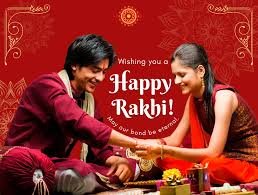
- Tying the Thread: With absolute love and attention, the sister ties the Rakhi around her brother’s right wrist. While tying the knot, she prays to the heavens for his career, health, and a long life.
- Sweetening the Bond: The sister feeds her brother a small piece of sweet, breaking any formal barrier, which the brother immediately reciprocates by feeding her back.
Phase 3: The Vow and Exchange of Gifts
Following the thread-tying, the brother bows down to touch the feet of his elder sister to seek blessings, or hugs his younger sister affectionately. He then offers her a carefully curated gift. Historically, this involved giving a silver coin or money for personal security. In the present era, it has transitioned into tech gadgets, elegant apparel, books, or customized experiences. Along with the physical gift, the brother explicitly promises to stand by her side through every milestone and struggle in life.
Regional Variations Across India
While the emotional core of Raksha Bandhan remains identical everywhere, India’s immense geographical diversity introduces fascinating regional localized traditions celebrated on the exact same full moon day of Shravana.
North and Central India
In regions like Punjab, Uttar Pradesh, Rajasthan, Haryana, and Delhi, the festival follows the standard sister-brother format on a grand scale. Extended families congregate for large feasts featuring Puri-Chole, Halwa, and Kheer. In Rajasthan, sisters also tie a special companion Rakhi known as a Lumba Rakhi onto the bangle of their sister-in-law (Bhabhi). This acknowledges that the sister-in-law shares the responsibility of protecting the family unit and welcoming the sister into her brother’s home.
Western India: Narali Purnima
In coastal states like Maharashtra, Goa, and parts of Karnataka, the day is celebrated as Narali Purnima (Coconut Full Moon). The day marks the official end of the harsh monsoon sea-storm season. The fishing communities offer golden coconuts (Naral) to the Lord of the Sea, Varuna, praying for safe voyages and a bountiful catch. Sibling celebrations happen concurrently, with families enjoying sweet coconut rice and coconut-stuffed dumplings (Modaks).
Southern India: Avani Avittam / Upakarma
In Tamil Nadu, Kerala, and parts of Andhra Pradesh, the day holds massive spiritual significance for the Brahmin community and is referred to as Avani Avittam or Upakarma. Rather than focusing solely on sibling dynamics, men change their sacred spiritual thread (Yajnopavitam or Janeu) after taking a ritual dip in holy water bodies. This symbolizes a spiritual rebirth, the washing away of past sins, and a renewed pledge to pursue Vedic studies and moral righteousness.
Eastern India: Jhulan Purnima and Shravani Purnima
In West Bengal and Odisha, the festival coincides with Jhulan Purnima, celebrating the divine romance of Lord Krishna and Radha on a decorated swing (Jhula). Temples are radically illuminated, and classical songs are sung. Furthermore, regional variations extend to tribal belts, where citizens walk into deep forests to tie Rakhis onto massive ancient banyan and neem trees, treating nature itself as a protective older sibling.
Modern Evolution: Rakhi in the 21st Century
Culture is fluid; it adapts to the needs of changing human generations without losing its sacred core values. Raksha Bandhan in 2025 showcases a wonderful fusion of ancient sentiments and progressive, modern sensibilities.
                  ┌──────────────────────────────┐
                  │ Raksha Bandhan Evolution     │
                  └──────────────┬───────────────┘
                                 │
         ┌───────────────────────┼───────────────────────┐
         ▼                       ▼                       ▼
┌──────────────────┐   ┌──────────────────┐   ┌──────────────────┐
│ Inclusive Bonds  │   │ Global & Digital │   │ Eco-Conscious    │
│ Sisters tie text │   │ E-Rakhis, Zoom   │   │ Plantable seeds, │
│ to friends, pets │   │ delivery platforms│   │ zero-plastic tags│
└──────────────────┘   ┌──────────────────┘   └──────────────────┘
1. Inclusivity and Breaking Gender Roles
Historically, the festival implied a patriarchal paradigm where a “strong brother” protects a “vulnerable sister.” Modern society has beautifully expanded this framework. Today, sisters who do not have brothers tie Rakhis to each other, promising mutual protection and lifelong support.
Furthermore, women proactively tie Rakhis to their close friends, mentors, single mothers, and even local law enforcement personnel or soldiers stationed at the borders (Border Security Force), honoring those who provide structural or physical security to the nation. It has transformed from a purely domestic ritual into a universal symbol of human solidarity.
2. The Digital Shift: Bridging Geographical Distances
With globalization, siblings are often separated by oceans and continents due to career paths or education. However, physical distance is no longer an obstacle to celebrating love. The rise of sophisticated e-commerce networks enables sisters to select premium designer threads online and have them delivered directly to international locations along with fresh boxes of sweets.
On the day of Raksha Bandhan, video conferencing platforms turn into virtual family halls. Brothers place smartphones on their desks, and sisters perform the Aarti virtually across the screen, while digital payment apps handle the instant transfer of monetary blessings, keeping the tradition alive across time zones.
3. The Green Rakhi: Eco-Consciousness
As global environmental awareness mounts, a wonderful trend has emerged: Eco-Friendly and Plantable Rakhis. Traditional Rakhis made with non-biodegradable plastics, chemical dyes, and toxic glues often end up tossed into landfills or water bodies after the festival, polluting the environment.
In response, artisans now create Rakhis using organic cotton, jute, and natural plant dyes embedded with living seeds (like tulsi, tomato, or marigold). Once the festival concludes, instead of discarding the thread, the brother buries the Rakhi in a pot of soil. Over the following weeks, the thread decomposes, and a beautiful green plant sprouts from the soil—acting as a literal, growing testament to the sibling’s everlasting love.
Conclusion: The Timeless Relevance of the Bond
Raksha Bandhan 2025 is a profound manifestation of human connection. It serves as an annual emotional audit for families, reminding siblings that no matter how intense their childhood arguments were, or how busy their corporate adult lives become, they have an foundational safety net in each other.
The thin, colorful thread tied onto the wrist carries an invisible weight far greater than steel chains. It carries the weight of shared memories, childhood secrets, silent sacrifices, and an absolute guarantee that you will never have to walk alone in this world. As families gather across India and globally on August 9, 2025, the tying of the Rakhi will once again ignite the timeless values of trust, protection, empathy, and joy—proving that some traditions only grow more beautiful with time.
About the Author