Nikumaroro
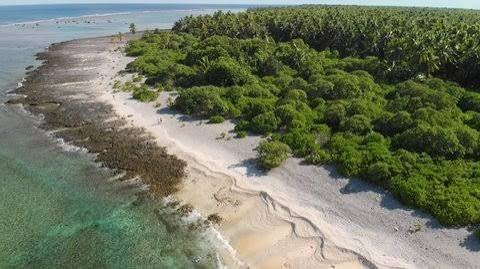
Measuring just 4.5 miles (7.2 km) long and 1.5 miles (2.4 km) wide, Nikumaroro is the epitome of an isolationist paradise—and a survivalist’s nightmare. It features a dense, tangled interior of Pisonia trees and scrub, surrounded by a razor-sharp coral reef that drops precipitously into thousands of feet of open ocean. There is no permanent surface fresh water.
Yet, despite its minuscule size and inhospitable environment, Nikumaroro is one of the most intensely studied islands in the world. For decades, it has been the focal point of a gripping historical detective story: the final resting place of legendary American aviator Amelia Earhart and her navigator, Fred Noonan.
1. Geographical Profile and Natural Environment
To understand why Nikumaroro became a crucible for human drama, one must first understand its brutal geography.
The Terrain
Nikumaroro is a classic coral atoll. It encircles a large, shallow lagoon that is completely cut off from the open ocean except for a few narrow, treacherous channels navigable only by small boats at high tide.
- The Reef: A wide, flat coral reef platform surrounds the island, acting as a natural barrier. At high tide, it is covered by a few feet of water; at low tide, it becomes a burning expanse of exposed coral.
- Flora: The island is thickly blanketed by Buka trees (Pisonia grandis), coconut palms, and dense Scaevola frutescens (beach cabbage) bushes, making travel inland exhausting and disorienting.
- Fauna: The atoll is overrun by millions of coconut crabs (Birgus latro)—the largest land-living arthropods in the world. Growing up to three feet across, these powerful, nocturnal scavengers are capable of cracking coconuts with their claws and eating carrion. The island is also home to thousands of nesting seabirds and Polynesian rats.
The Water Crisis
The defining characteristic of Nikumaroro is its lack of reliable fresh water. While it receives seasonal rainfall, the porous coral soil cannot hold water on the surface. Hypothecial castaways or settlers are entirely dependent on capturing rainwater or digging precarious wells down to a thin, brackish freshwater lens floating atop the denser seawater beneath the island.
2. Early History and Western “Discovery”
Long before Western sailors mapped the Pacific, Micronesian and Polynesian voyagers likely encountered Nikumaroro. However, its lack of fresh water prevented any permanent pre-European settlement.
The Whaling Era
The island was “discovered” multiple times by Westerners in the early 19th century:
- The Kemish (1824): Captain Kemi of a British whaling ship sighted the island.
- The Gideon Barstow (1828): Captain Joshua Coffin spotted it and named it Gardner Island, likely after his ship’s owner, Gideon Gardner. The name stuck in Western geography for the next century and a half.
In 1892, Great Britain formally annexed the island during the scramble for Pacific territories, claiming it under the Guano Islands Act, though no significant guano mining ever took place due to the low quality of the deposits.
3. The Amelia Earhart Connection: The “Castaway” Hypothesis
The primary reason Nikumaroro is a household name among historians is its connection to July 2, 1937—the day Amelia Earhart and Fred Noonan vanished during their attempt to circumnavigate the globe in a twin-engine Lockheed Electra 10E.
The Niku Hypothesis vs. The Crash-and-Sink Theory
The official consensus is that Earhart ran out of fuel and crashed into the deep ocean near her intended destination, Howland Island, which lies about 350 miles (560 km) north-northwest of Nikumaroro.
However, TIGHAR (The International Group for Historic Aircraft Recovery) has spent decades compiling evidence for the Nikumaroro Hypothesis. This theory posits that Earhart and Noonan, unable to find Howland Island, flew along a radio “line of position” ($157^\circ / 337^\circ$) broadcasted by Earhart in her final transmission. Flying south-southeast on this line brings an aircraft directly to Nikumaroro.
The Evidence for Nikumaroro
Proponents of this theory point to several compelling, though fiercely debated, pieces of evidence:
- Post-Loss Radio Signals: In the days following Earhart’s disappearance, international radio operators and amateurs picked up dozens of shortwave radio distress calls. Analysts from TIGHAR argue that several of these signals were authentic transmissions from the Electra. Because the radio required the aircraft’s right engine to run to charge the batteries, the plane must have been on dry land, not at the bottom of the ocean.
- The 1937 Flyover: On July 9, 1937—seven days after the disappearance—planes from the US Navy battleship USS Mississippi flew over Gardner Island. They reported “signs of recent habitation,” though they ultimately concluded no one was there, assuming the signs were from occasional local fishermen.
- The Norwich City Wreck: In 1929, a British freighter named the SS Norwich City ran aground on the reef of Nikumaroro. It has been hypothesized that Earhart landed her plane on the smooth, flat reef nearby at low tide, and that the survivors may have salvaged resources from the massive, rusting shipwreck.
4. The Mystery of the 1940 Bones
The most haunting piece of the Nikumaroro puzzle unfolded in 1940. Gerald Gallagher, a British colonial officer and the first administrator of the newly formed settlement on the island, discovered a human skeleton hidden in a remote area of the atoll, near a site nicknamed the “Seven Site.”
Discovery at the Seven Site
Alongside the partial skeleton, searchers found:
- A bottle of Benedictine liqueur (a favorite of Earhart’s).
- A man’s leather shoe sole and a woman’s shoe sole (resembling Earhart’s size).
- A box that once held a sextant (a navigation tool), with serial numbers matching the type Fred Noonan used.
- Evidence of a small campfire, where bones of birds, turtles, and coconut crabs showed signs of being cooked and eaten.
The Lost Analysis
The bones were shipped to Fiji for analysis by Dr. David W. Hoodless, a British medical acting principal. In 1941, Hoodless concluded that the bones belonged to a short, stocky European male, effectively ruling out Earhart (who was tall and slender).
Tragically, the bones were subsequently lost in the bureaucratic chaos of World War II. However, in the late 1990s and 2010s, forensic anthropologists re-examined Dr. Hoodless’s surviving measurements using modern data metrics.
In 2018, a study by forensic anthropologist Dr. Richard Jantz concluded that the bone measurements shared a much higher statistical similarity to Amelia Earhart than to 99% of individuals in a large reference database. Jantz argued that Hoodless had used outdated 19th-century methods to determine sex and ancestry.
The Scavenger Factor
Critics ask: If a full skeleton was there, why were only 13 bones recovered? The answer likely lies with Nikumaroro’s infamous coconut crabs. These creatures are known to carry shiny objects and biological matter away into their underground burrows. If a human died on the island, their remains would be scattered across the atoll within weeks by thousands of crabs.
5. The Phoenix Islands Settlement Scheme (1938–1963)
While the world remembers Nikumaroro for Earhart, the island has its own tragic human history involving a forgotten colonial experiment: The Phoenix Islands Settlement Scheme (PISS).
       [ Government Strategy: 1930s-1940s ]
Gilbert Islands (Overcrowded) ───> Relocation ───> Phoenix Islands (Drought-Prone)
                                                      │
                                                      ▼
                                            1963: Total Evacuation
Colonizing the Uninhabitable
In the late 1930s, the British Empire sought to alleviate overcrowding in the Gilbert Islands (now Kiribati) by migrating families to the uninhabited Phoenix Islands: Sydney (Manra), Hull (Orona), and Gardner (Nikumaroro).
In December 1938, settlers arrived on Nikumaroro. They cleared land, built a village called Mairiki, established a cooperative store, erected a radio station, and planted thousands of coconut palms to jumpstart a copra (dried coconut meat) economy. By the 1950s, the island’s population hovered around 100 people.
The Collapse
The experiment was doomed by nature. Nikumaroro’s lack of fresh water proved fatal to a permanent society. The island was struck by severe, prolonged droughts in the 1950s and early 1960s. The coconut palms withered, the wells turned completely salty, and the settlers faced starvation.
In 1963, the British government officially abandoned the project. The entire population of Nikumaroro was evacuated and resettled in the Solomon Islands. Once again, Nikumaroro was left to the crabs and the elements.
6. Modern Expeditions and Scientific Scrutiny
In the 21st century, Nikumaroro became a high-tech archaeological site. TIGHAR has led more than a dozen expeditions to the island, utilizing ground-penetrating radar, underwater sonar, and even forensic bone-sniffing dogs.
Artifacts Recovered
Over the years, expeditions have pulled several intriguing artifacts from the abandoned village site and the Seven Site:
- Aluminum Scrap: A panel of aluminum sheet metal found on the island matches the dimensions and rivet patterns of a patch applied to Earhart’s Electra during a stopover in Miami.
- Cosmetic Jars: Fragments of a small glass jar were identified as Dr. Berry’s Freckle Ointment, a skin-bleaching cream popular in the 1930s. Historical records show Earhart disliked her freckles.
- DNA Attempts: In recent years, scientists have attempted to extract environmental DNA (eDNA) from the soil at the Seven Site where the bones were found, hoping to find traces of female European DNA, though results have remained inconclusive due to the degrading tropical climate.
The Deep-Sea Counter-Argument
Despite the romance of the Nikumaroro theory, many oceanographers and historians remain staunchly skeptical. Deep-sea exploration companies, such as Nauticos and Ocean Exploration Trust, have focused their efforts on scanning the abyssal plains around Howland Island. They argue that Earhart’s final radio signals indicate she was low on fuel, making the 350-mile flight to Nikumaroro mathematically impossible. They believe the island’s artifacts are simply debris left behind by 1930s Coast Guard personnel, the Norwich City crew, or the later Gilbertese colonists.
7. Nikumaroro Today: A Pristine Marine Sanctuary
Today, Nikumaroro has transitioned from a historical crime scene to an environmental treasure. It is part of the Phoenix Islands Protected Area (PIPA), which was designated a UNESCO World Heritage site in 2010. PIPA is one of the largest marine protected areas on Earth, encompassing over 150,000 square miles of open ocean and coral habitats.
       [ Nikumaroro Current Status ]
             UNESCO Protected
                    │
   ┌────────────────┴────────────────┐
   ▼                                 ▼
Pristine Marine Ecosystem      Uninhabited Laboratory
(No commercial fishing)       (Strictly controlled access)
Because human access is strictly regulated, Nikumaroro’s ecosystem has rebounded spectacularly. The waters surrounding the atoll are teeming with:
- Large populations of grey reef sharks and manta rays.
- Pristine, unbleached coral reefs.
- Healthy populations of endangered green sea turtles.
The island stands as a living laboratory for scientists studying climate change, coral resilience, and island restoration, entirely free from the footprint of modern industrialization.
Conclusion: The Island That Keeps Its Secrets
Nikumaroro remains a place of profound duality. To biologists, it is a crown jewel of marine conservation, an untouched paradise where nature rules supreme. To historians and aviation enthusiasts, it is a psychological labyrinth—a tragic stage where America’s most famous aviator may have spent her final, terrifying days watching the horizon for a rescue that never came.
Whether the “Niku Hypothesis” is eventually proven true by some future technological breakthrough, or whether it remains a beautifully constructed myth, the island itself does not care. As the Pacific surf continues to batter the rusting skeleton of the SS Norwich City and the coconut crabs patrol the shaded floor of the Buka forests, Nikumaroro guards its secrets fiercely, wrapped in the lonely silence of the open sea.
About the Author